Last updated: September 13, 2026
By Camron Chappelle of American Gutter Service, a licensed Oregon gutter contractor (CCB #110122).
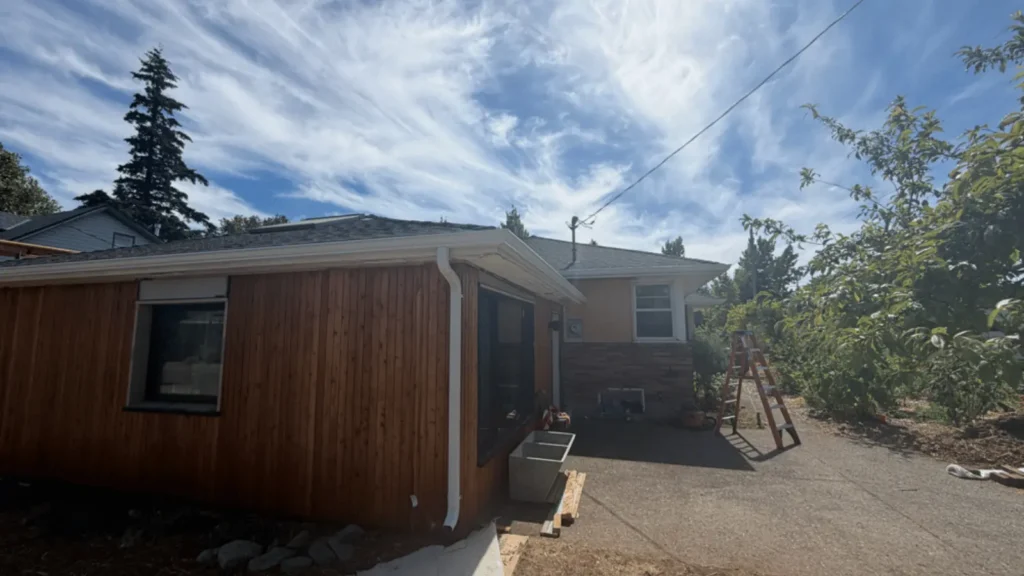
Seamless gutters are gutter runs formed on site from a single coil of metal and cut to the measured length of each stretch of roofline, so there are no joints in the middle of a straight run. Joints still exist where they are structurally necessary: at corners, end caps, outlets and downspout connections. The word describes the run, not the whole system.
Quick Takeaways
- A seamless gutter is one continuous length of metal, usually aluminum, formed at the property to fit a specific roofline rather than cut from pre-made sections.
- Seamless does not mean joint-free. Corners, end caps, outlets and downspout connections are still assembled and sealed on every system.
- The main advantage is that the joints most likely to work loose over time, the ones spaced every few feet along a straight run, are removed.
- The main trade-off is that the gutter has to be fabricated and installed by a contractor with a gutter machine, so the upfront cost is higher than off-the-shelf sectional gutter a homeowner can hang themselves.
What Are Seamless Gutters?
Seamless gutters are continuous gutter runs custom formed from flat metal coil to match the measurements of a particular roof edge.
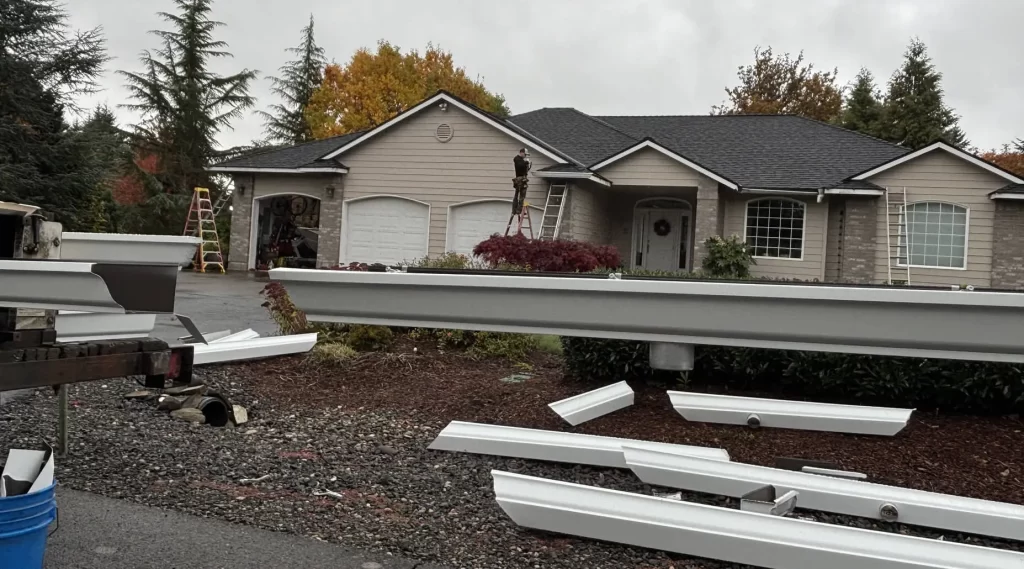
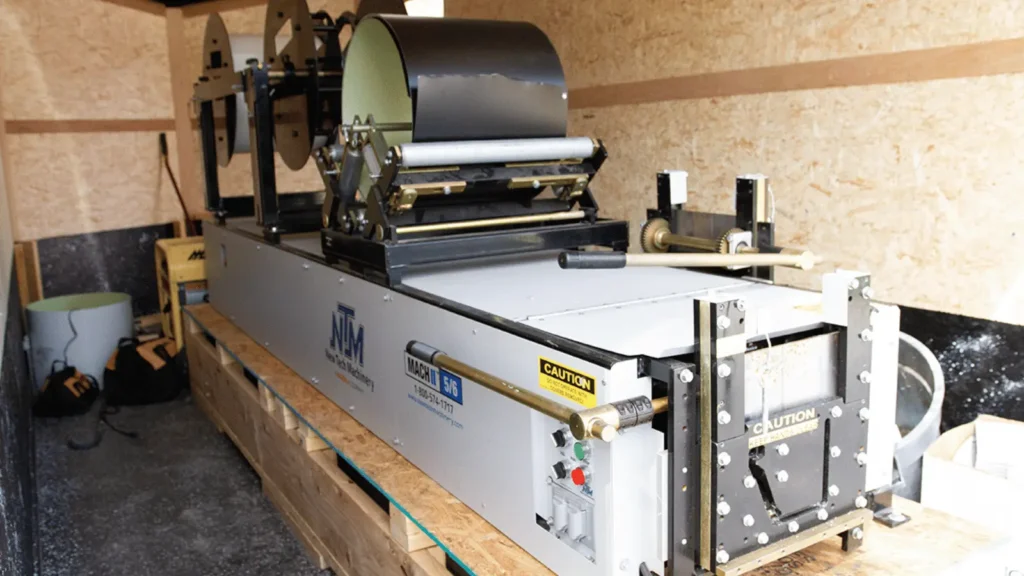
A crew measures each run of fascia, feeds coil stock through a portable roll-forming machine parked at the property, and produces a length of finished gutter profile cut to that exact measurement. A 38-foot eave gets a 38-foot piece of gutter. Nothing is joined in between.
Sectional gutter works the other way around. It arrives as pre-made lengths, commonly 10 feet, and the installer assembles a long run by connecting several pieces with slip joints or connectors and sealant. Both products end up looking similar from the driveway. The difference is in how many connections sit inside the run.
Where seamless gutters still have seams
This is the part most articles skip, and it is the part homeowners most often get wrong.
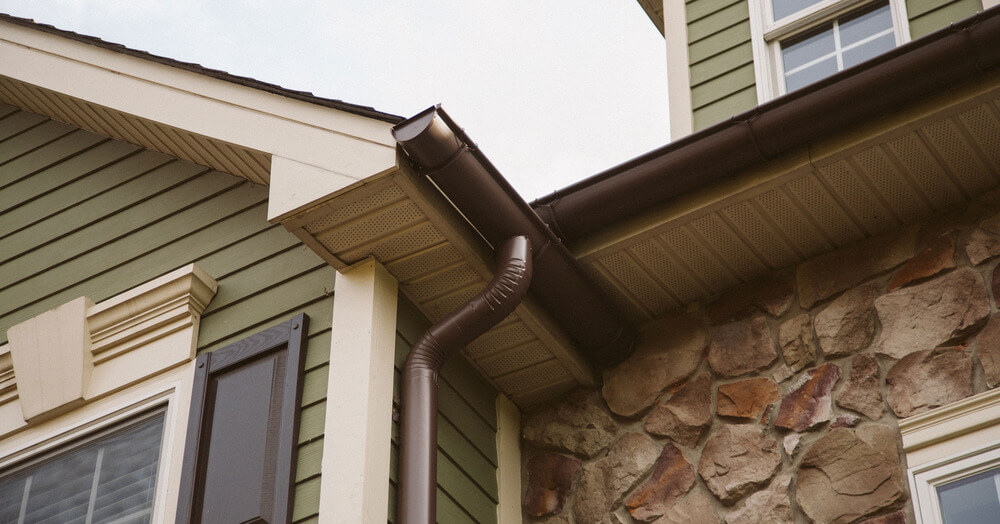
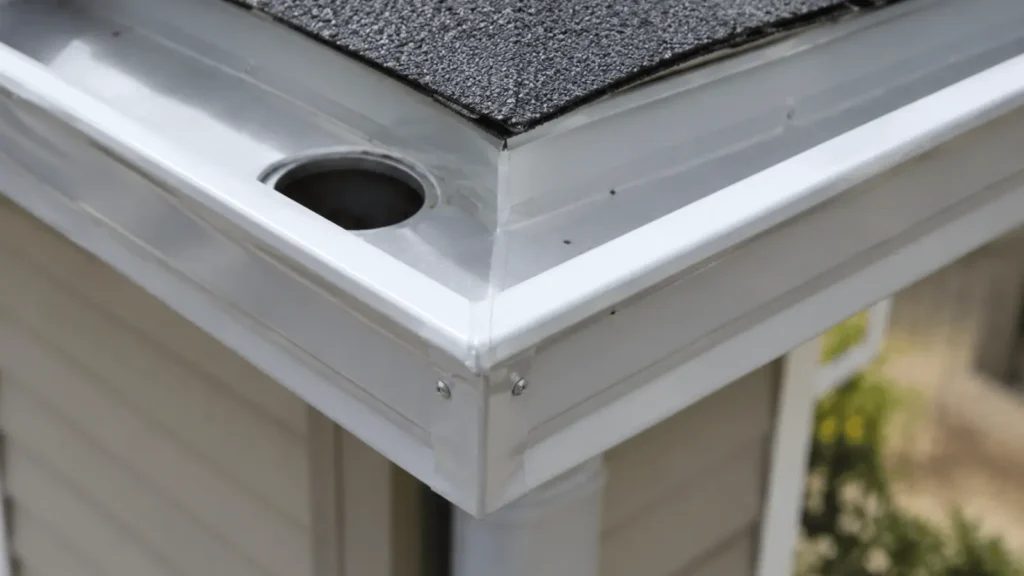
Every gutter system has to change direction, terminate and drain. Those three things require connections regardless of how the straight sections were produced:
- Corners and mitres. Where the roofline turns an inside or outside corner, two runs meet and are joined and sealed.
- End caps. The open end of a run is closed with a cap that is crimped, riveted or sealed in place.
- Outlets. A hole is cut in the gutter floor and an outlet is fitted so water can reach the downspout.
- Downspout connections. Elbows and downspout sections connect below the outlet.
So a house with a simple rectangular roofline might have a handful of connections instead of many. A house with dormers, bays and a stepped roofline will have more, because it has more corners. The number depends on the shape of the roof, not on the marketing term.
Profile and material are separate decisions
Seamless versus sectional describes how the gutter was produced. It says nothing about:
- Profile. K-style and half-round describe the cross-section shape. Both exist in seamless and sectional form.
- Size. 5-inch and 6-inch describe the opening width. Both are formed seamlessly.
- Material. Aluminum, steel and copper are all available seamless. Material affects weight, rigidity, corrosion behaviour and price.
Homeowners often treat these as one decision. They are four, and a quote should address all of them separately.
How Are Seamless Gutters Made?
Seamless gutters are made at the property, not at a factory, because the finished length has to match a roofline that nobody can know in advance.
The sequence is straightforward:
- Measure. Each run of roof edge is measured, and the crew notes corner locations, existing outlet positions, fascia condition and where water needs to discharge.
- Load the coil. A roll of flat coil stock in the chosen material and colour is loaded into the forming machine.
- Form the profile. The machine pulls the flat coil through a series of rollers that progressively bend it into the finished gutter shape.
- Cut to length. The formed gutter is cut to the measured run length.
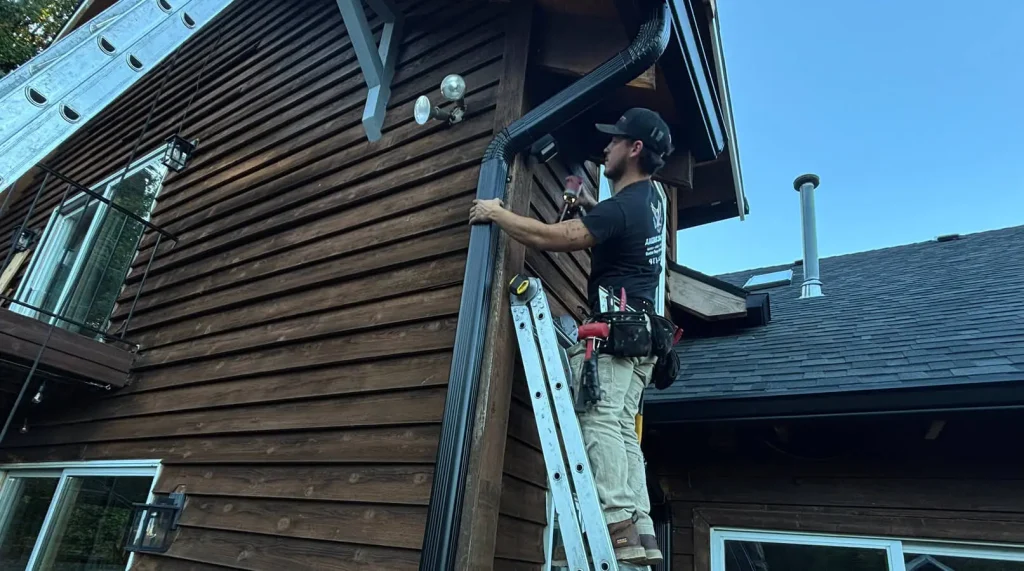
- Install. The run is hung on the fascia with hangers, set to a slope that carries water toward the outlets, then corners, end caps, outlets and downspouts are fitted and sealed.
Two details in that sequence matter more than the fabrication itself.
Slope. A gutter that is dead level holds standing water, which collects grit and accelerates corrosion. Sheet metal technical guidance commonly calls for at least a slight continuous fall toward each outlet, on the order of 1/16 inch per foot as a minimum, with more fall usually preferred where it will not be visible against the roofline. Slope is set during installation and cannot be fixed later without rehanging the run.
Outlet placement. An outlet has to sit where water actually collects, which depends on roof geometry and where valleys concentrate runoff, not on where the downspout would be most convenient to route.
American Gutter Service forms K-style runs on site after measuring the actual roofline, and plans outlet and downspout positions before anything is hung. More detail on that sequence is on the seamless gutter installation page.
Seamless Gutters vs Pre-Cut Gutters
The practical difference is the number of connections inside each run, and who can install the system.
| Feature | Seamless gutters | Pre-cut (sectional) gutters |
|---|---|---|
| Construction | One continuous run formed on site from coil | Pre-made lengths joined together, commonly 10 ft pieces |
| Intermediate joints | None along a straight run | A joint at every section connection |
| Installation | Professional, requires a roll-forming machine | Can be done by a homeowner with common tools |
| Repairs | Damage usually means replacing or patching a long run | A single damaged section can be unclipped and swapped |
| Maintenance | Fewer sealed joints to inspect and reseal | Sealant at each connector needs periodic attention |
| Appearance | One unbroken line along the eave | Visible connectors at regular intervals |
| DIY suitability | Not practical | Widely available at home improvement stores |
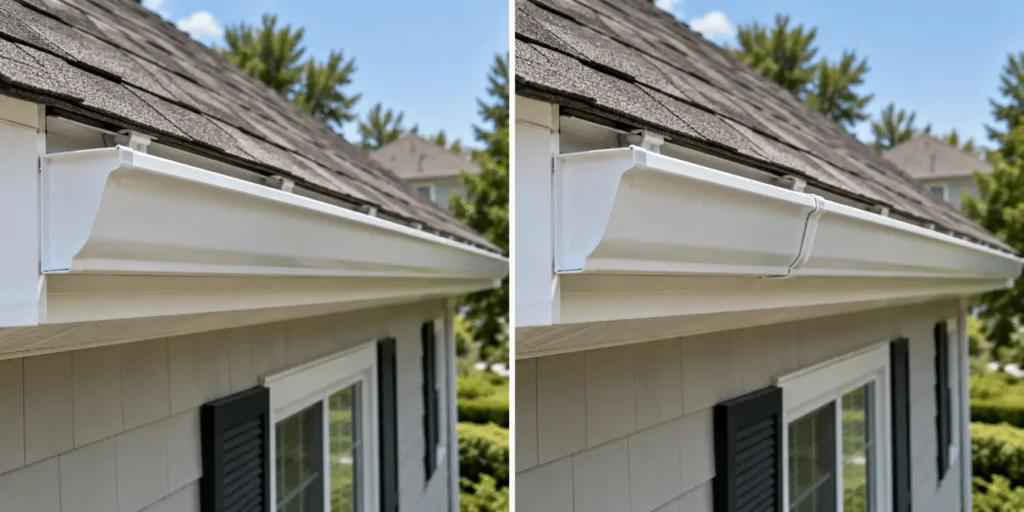
Both terms describe the same thing when you hear “pre-cut” and “sectional”. They are used interchangeably in the trade.
For a fuller side-by-side including cost and lifespan, see the dedicated comparison: pre-cut vs seamless gutters.
Benefits of Seamless Gutters
The benefits of seamless gutters come from two things: the absence of mid-run connections, and the fact that the gutter is made to fit one specific house.
Fewer intermediate joints means fewer joint-related failure points. Sealed connections are consumable. Sealant hardens and shrinks with age and temperature cycling, fasteners loosen, and debris packs into the small ledge a connector creates. Removing those connections from the run removes that category of failure from the run. It does not remove it from the corners and outlets, which are still sealed connections.
A custom fit to the roofline. Runs are formed to measured lengths, so a long eave is covered by one piece rather than several. There is also very little offcut waste compared with trimming pre-made lengths to fit.
Fewer places for debris to catch inside the run. A connector creates a small lip on the gutter floor where needles and grit accumulate. A continuous run has a smooth floor. This reduces snag points. It does not reduce how much debris lands in the gutter in the first place.
A cleaner line along the eave. With no connectors every few feet, the roof edge reads as one continuous line. On a long straight elevation the difference is visible from the street.
Fewer joints to reseal over the life of the system. Maintenance attention shifts to a small number of corners and outlets rather than being spread across every connection in the run.
Availability in common residential profiles and materials. Seamless is not a niche product. It is the standard way residential gutter is installed in most of the United States, in the profiles and materials homeowners already expect.
What Are the Disadvantages of Seamless Gutters?
A fair account of the advantages and disadvantages of seamless gutters has to include the following.
Professional fabrication and installation are required. The forming machine is a significant piece of equipment and the work takes practice. There is no realistic homeowner path to a seamless gutter.
Higher upfront cost than a DIY sectional system. Seamless gutter is custom fabricated and professionally installed, so the upfront price sits above buying sections and hanging them yourself. For what that means in this market, see gutter installation cost in Oregon.
Damage to a run is less convenient to repair. If a falling branch dents a section of continuous gutter, there is no 10-foot piece to unclip and replace. The repair usually involves patching or reforming a length of the run, which means a return visit from a contractor.
Joints still exist, and they can still fail. Corners, outlets and end caps are sealed connections with the same ageing behaviour as any other sealed connection. They are simply fewer in number.
Installation quality still decides performance. This is the most important caveat on the page. A seamless gutter hung with too little slope, undersized for the roof area it serves, fitted with too few outlets, or fastened to soft fascia will underperform a well-installed sectional system. Construction method is one variable among several.
What Are the Advantages and Disadvantages of Pre-Cut Gutters?
Pre-cut gutters, also sold as sectional gutters, have a real place.
Advantages
- Lower material cost, and available off the shelf.
- A genuine DIY option for a homeowner comfortable working at height.
- Individual sections can be replaced without touching the rest of the run.
Disadvantages
- More intermediate joints along every run.
- More connections that depend on sealant, which ages.
- More ongoing joint maintenance.
- Visible connectors along the eave.
The detailed version of this comparison, including cost and lifespan by material, lives on the pre-cut vs seamless gutters page.
What Materials Can Seamless Gutters Be Made From?
Any material that can be supplied as coil and bent through a forming machine can be produced as a seamless run. In practice that means metal.
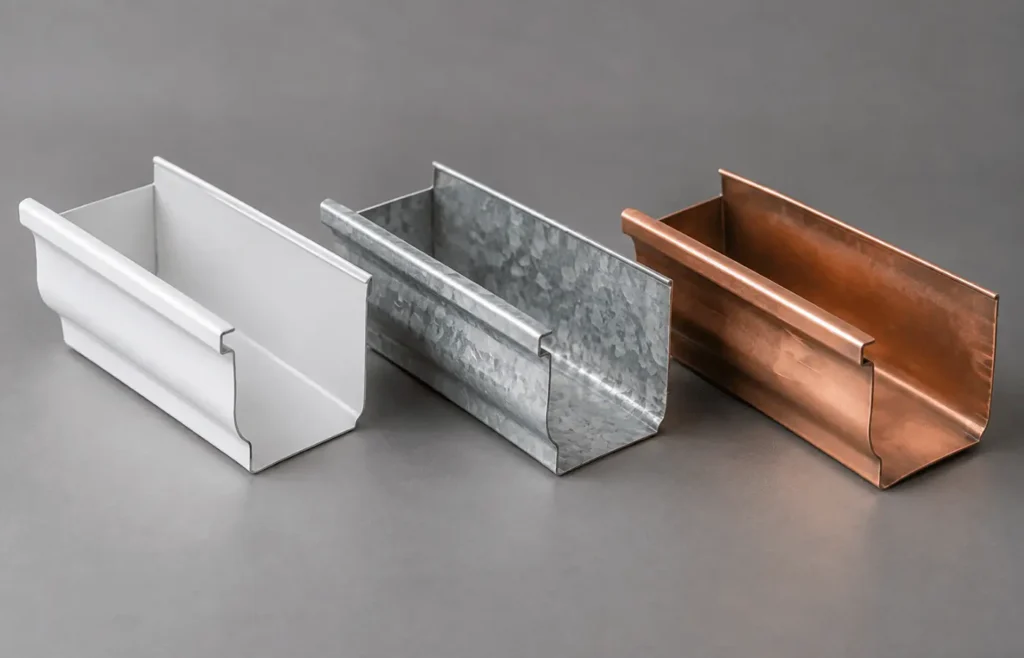
Aluminum
Aluminum is the common residential choice. It is light enough to handle in long lengths on a ladder, it does not rust, it holds a factory-applied finish well, and it is affordable relative to the alternatives. Its weak point is rigidity: aluminum dents under impact from a falling branch or a carelessly placed ladder. Heavier gauges resist this better than lighter ones, which is a reasonable thing to ask about when comparing quotes.
Aluminum is the primary material American Gutter Service installs for residential seamless work, in standard white and selected premium finishes.
Steel
Seamless steel gutters are roll-formed from steel coil in the same way aluminum is. Steel is stiffer, so it resists denting and holds its shape better under the weight of ladders, ice or debris. The trade-offs are weight, which makes handling and hanging long runs harder, and corrosion: steel depends on its galvanized or coated surface, and once that surface is breached by a scratch, a cut edge or abrasion, rust can start. Steel is more commonly specified on commercial buildings and in regions with heavy snow load than on typical Pacific Northwest homes.
Copper
Copper is the premium option. It is durable, it does not need painting, and it weathers to the patina many owners want on historic and architect-designed homes. It is substantially more expensive than aluminum, requires more skilled fitting at corners and outlets, and is worth theft consideration in some areas. American Gutter Service offers real copper systems by custom estimate rather than at a published per-foot rate, because a copper job has to be planned around the specific home.
One point worth knowing: “copper metallic” or similar names on a colour chart are paint finishes on aluminum. They are not copper and will not weather like copper.
What about vinyl?
Vinyl belongs in a discussion of gutter materials, but not in a discussion of seamless gutter materials. Vinyl gutters are manufactured as pre-formed lengths and joined with connectors on site. They are a sectional product by construction. Older content that lists vinyl alongside aluminum, steel and copper as a “seamless material” is conflating two different things.
| Considering seamless gutters for an Oregon home? American Gutter Service can measure the roofline, look at how water moves across the roof and recommend the gutter size, outlet layout and downspout configuration the property actually needs. See seamless gutter installation. |
Are Seamless Gutters Worth It?
For most owner-occupied homes with a contractor doing the work anyway, yes. For every situation, no.
Seamless generally makes sense when:
- You expect to own the home for a while, so reduced joint maintenance is worth something to you.
- The roofline has long uninterrupted runs, where sectional gutter would need the most connections.
- Professional installation is already part of the plan, which means the fabrication step adds no extra mobilisation.
- The appearance of the roof edge matters to you.
Pre-cut sectional gutter is still a reasonable choice for:
- Sheds, detached shops and small outbuildings.
- Temporary coverage before a planned roof replacement or renovation.
- A genuine DIY project where the owner accepts the maintenance that comes with it.
- Very tight budgets where the alternative is no gutter at all.
One thing seamless construction is not: a substitute for correct sizing and drainage design. A continuous run that is too small for the roof area feeding it, or that drains to a single undersized downspout, will overflow in a heavy storm no matter how few joints it has.
Are Seamless Gutters Good for Oregon Homes?
They suit the climate well, but for a slightly different reason than most people assume.
Western Oregon rain is characterised by frequency and duration rather than extreme short bursts. Portland records measurable precipitation on a majority of days through the winter months. Two practical consequences follow:
A small leak is a long leak. A failing joint in the Willamette Valley is not dripping during a summer thunderstorm and then drying out for a month. It is running through most of a wet season, into the fascia, down the wall or into the ground beside the foundation. Reducing the number of joints that can fail matters more in a climate that keeps them wet.
Gutter size is set by peak intensity and roof area, not annual rainfall totals. This is where sizing decisions actually get made. Under the International Plumbing Code approach to storm drainage, gutters are sized from the flow rate coming off the roof, which is a function of the roof area draining to that run and a short-duration rainfall intensity for the location, with adjustment for roof pitch. Annual inches do not enter the calculation. That is why a Columbia County house with a big roof and converging valleys may need 6-inch K-style gutters while a neighbouring home in the same rainfall is fine on 5-inch.
Two further Pacific Northwest specifics:
Fir and cedar debris. Needles are the region’s defining gutter nuisance. They are fine enough to pass through coarse screens, they mat together, and they hold moisture that feeds moss growth in the trough. No gutter construction method changes this. It is a cleaning and gutter protection question, not a seamless question.
Roof valleys. Older Portland-area homes often have steep pitches and complex rooflines. A valley collects water from two roof planes and delivers it to one point on the gutter. If the outlet is not near that point, water travels the length of the run before it can drain, and overflows at the corner during heavy rain.
What to Look for in a Seamless Gutter Quote
Because construction method alone does not determine how the system performs, these are the things worth checking on any estimate, from any contractor:
- Gutter size, and the reason for it. If a quote specifies 5-inch or 6-inch without any reference to roof area, pitch or valleys, the size was assumed rather than determined.
- Outlet count and placement. Ask how many downspout drops the layout calls for and where they sit relative to valleys.
- Downspout size. 2×3 and 3×4 are not interchangeable. Downspout capacity is part of the design, not an afterthought.
- Hanger type and spacing, and whether hangers are included in the price. Hidden hangers with screws into sound fascia are the current standard.
- Fascia condition. Nobody can fully assess the fascia until the old gutter comes off. Ask what happens, and what it costs, if rot is found underneath.
- Material and gauge, and whether the colour is a finish or the actual metal.
- What the discharge plan is. Where does the water go once it leaves the downspout, and is that far enough from the foundation.
- Whether the finished system is water tested before the crew leaves.
A contractor giving a firm per-foot price over the phone, without seeing the roofline, is estimating rather than quoting.
Frequently Asked Questions
Are seamless gutters completely seamless?
No. Seamless refers to the straight runs, which are formed as one continuous piece with no joints in the middle. Every system still has connections at corners, end caps, outlets and downspout fittings, because a gutter has to change direction, terminate and drain.
What is the difference between seamless and regular gutters?
The difference is how the run is produced. Seamless gutter is formed on site from coil and cut to the measured length of each run. Regular, or sectional, gutter is assembled from pre-made lengths joined with connectors and sealant. The seamless run has no intermediate joints; the sectional run has one at every connection.
Can seamless gutters leak?
Yes. Seamless gutters can leak at corners, end caps, outlets and downspout connections, where sealed connections still exist. They can also leak or overflow because of failed sealant, loose hangers, physical damage, incorrect slope, undersized gutter for the roof area or blockage from debris. Fewer intermediate joints means fewer joint-related failure points, not a system that cannot leak.
Can you DIY seamless gutters?
Not realistically. The gutter is formed by a roll-forming machine that a homeowner is unlikely to own or rent, and hanging long continuous runs at the correct slope is a two-person job. Sectional gutter is the practical DIY option.
Are seamless gutters aluminum or steel?
Both exist. Aluminum is the common residential material because it is light, rust-free and affordable. Steel is also roll-formed seamless and is stiffer, but it is heavier and depends on its coating to resist corrosion. Copper is the premium option. The material is a separate choice from seamless construction.
What are seamless steel gutters?
Seamless steel gutters are continuous gutter runs roll-formed from steel coil rather than aluminum coil. The forming process is the same. Steel offers greater rigidity and dent resistance, which is why it appears more often on commercial buildings and in heavy snow regions. The trade-offs are added weight during installation and corrosion risk wherever the galvanized or painted surface is breached.
How long do seamless gutters last?
There is no single number that applies to every system. Service life depends on the material, the quality of the installation, the environment the gutter sits in and how well it is maintained. Aluminum lasts a long time in Oregon’s climate because it does not rust, but a well-made gutter hung on rotten fascia, or one that holds standing water because it was set level, will fail early. Sealant at corners and outlets is a wear item on any system and should be expected to need attention periodically.
Do seamless gutters still need cleaning?
Yes. Fewer intermediate joints does not stop leaves, fir needles, moss or roof grit from landing in the gutter. A continuous run has fewer ledges for debris to catch on, which helps, but the trough still fills and still has to be cleared. Gutter protection reduces cleaning frequency; it does not eliminate maintenance.
Are pre-cut gutters the same as sectional gutters?
Yes. Both terms describe gutter supplied in standard pre-made lengths and joined on site with connectors and sealant, as opposed to formed as one continuous run.
About American Gutter Service
American Gutter Service is a gutter contractor based in St. Helens, Oregon, serving Columbia County and the Portland metro area. The company holds Oregon CCB #110122, has worked on local rooflines for more than 20 years, and fabricates seamless gutter runs on site rather than subcontracting the work. More about the team.
If you want a specific answer for your own roof, we can measure the property and provide a written estimate that itemises gutter footage, downspouts, corners and any roof-edge work the house needs. See seamless gutter installation.