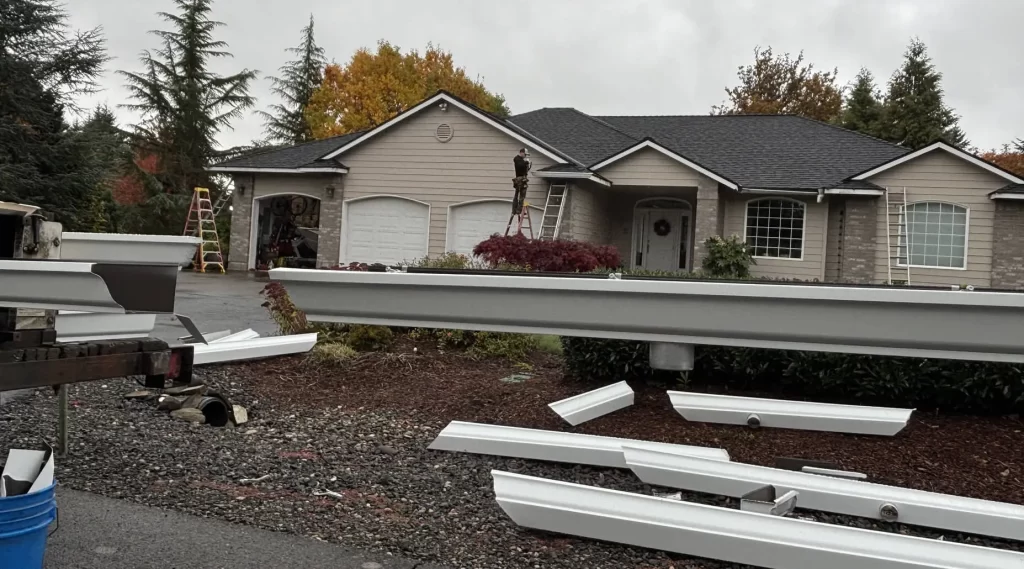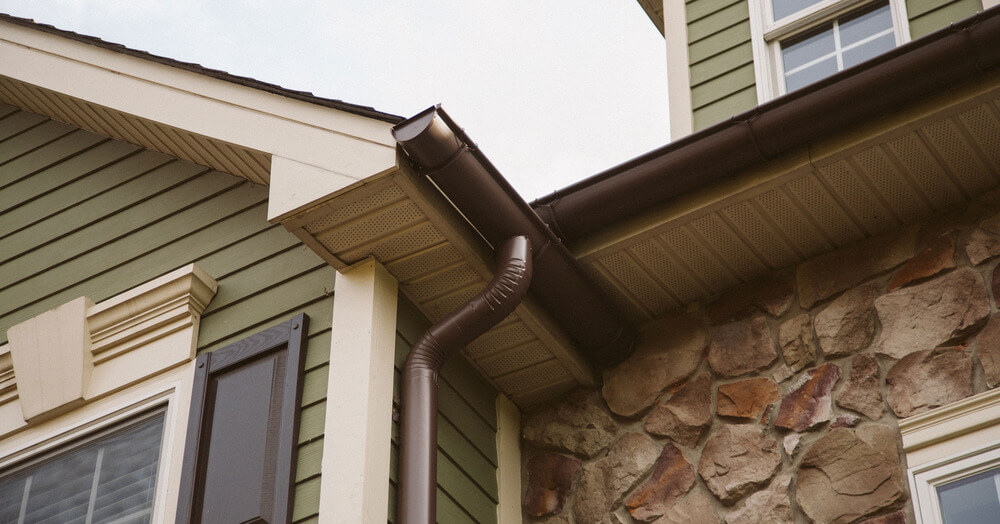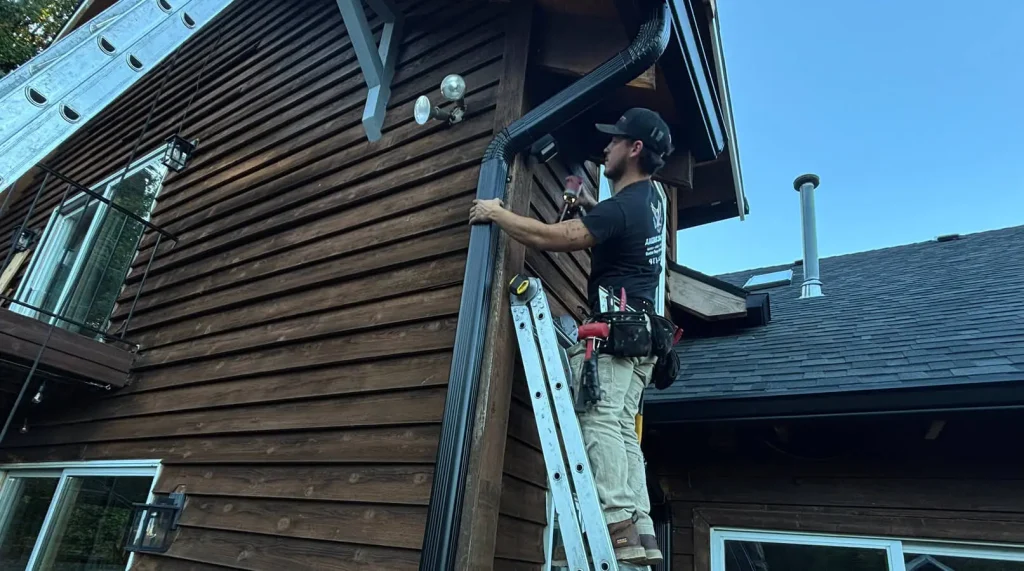
Downspouts should drain at least 4 to 6 feet away from your home’s foundation — and 10 feet is ideal. Water should discharge onto ground that slopes away from the house, or into a buried drain line, dry well, rain garden, or approved storm system. A downspout that dumps water directly beside the foundation is one of the most common causes of basement leaks, crawlspace moisture, and foundation settling we see on Oregon homes.
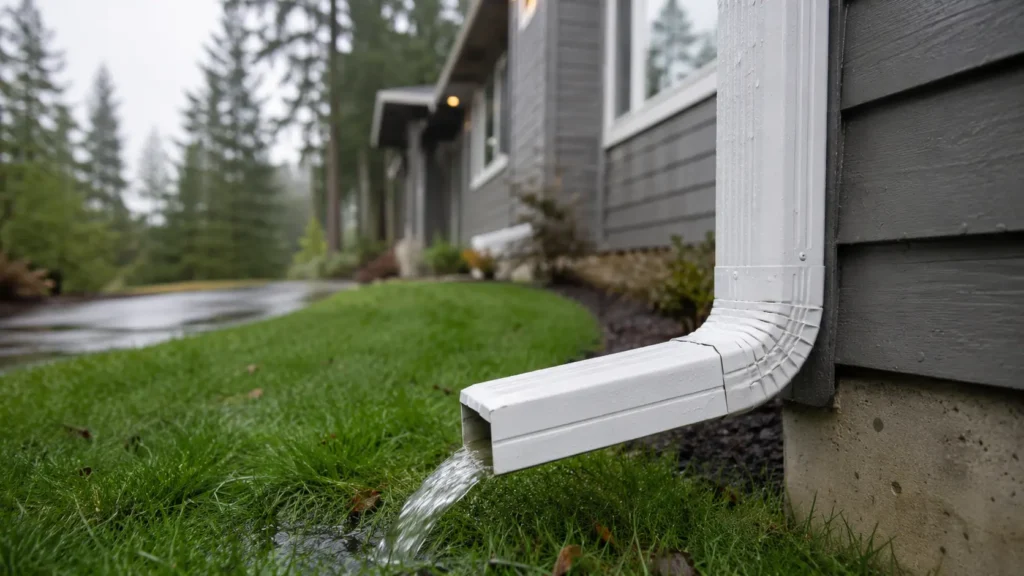
Why Downspout Drainage Matters (Especially in Oregon)
Here’s the math most homeowners never run: an average 2,000-square-foot roof sheds roughly 1,250 gallons of water for every inch of rain. Most of the Portland metro and Columbia County receives 36 to 50+ inches of rain per year, which means your gutters funnel somewhere between 45,000 and 60,000 gallons through your downspouts annually. Where all of that water lands is not a small detail, it’s the difference between a dry crawlspace and a five-figure foundation repair.
When downspouts discharge too close to the house, that water saturates the soil against your foundation. Over an Oregon winter, the consequences stack up:
- Hydrostatic pressure — saturated soil pushes against foundation walls, opening cracks and forcing water through them.
- Crawlspace moisture — most older Oregon homes sit on crawlspaces, and standing water under the house feeds mold, wood rot, and pests.
- Soil erosion and settling — repeated soaking washes out and compacts the soil unevenly, leading to settling slabs, sticking doors, and cracked walkways.
- Basement leaks and flooding — the #1 source of wet basements isn’t groundwater. It’s roof water put back beside the foundation by a short downspout.
One caveat before we go further: drainage only matters if the water actually makes it into the downspout. Clogged or leaking gutters dump water at the roofline before it ever reaches the ground — so if your gutters overflow during storms, fix that first. (In the fir-heavy Pacific Northwest, that usually means cleaning twice a year or installing gutter guards.)
How Far From the Foundation Should Downspouts Drain?
The minimum safe distance is 4 to 6 feet from the foundation. The ideal distance is 10 feet. For homes with basements, lean toward the longer end, basement walls sit deeper in the saturated zone and have far more to lose.
Building code backs this up. The International Residential Code (Section R801.3) requires roof drainage to discharge at least 5 feet from foundation walls, or into an approved drainage system, where expansive or collapsible soils exist. Code also calls for the ground itself to fall at least 6 inches within the first 10 feet from the foundation.
Put those two rules together and you get the real-world test: water leaving your downspout should land on ground that slopes away from the house and keep moving. If your yard slopes back toward the house, common on hillside lots in St. Helens, Scappoose, and the West Hills, a surface extension isn’t enough. You’ll need a buried line that carries water past the low spot.
6 Places Downspouts Can Drain (Ranked for Oregon Homes)
There’s no single right answer, the best option depends on your lot’s slope, your soil, and how much you care about appearances. Here are the six options we recommend, starting with the simplest.
1. Splash Blocks and Above-Ground Extensions
The simplest fix: a splash block or a rigid/flexible extension that carries water 4–6 feet out before releasing it. Costs $5–$25 per downspout and takes minutes to install.
This is the right answer when your yard already slopes away from the house. The downside: extensions get kicked loose, crushed by mowers, and removed “temporarily” forever. Check them every fall.
2. Buried Downspout Extensions (Our Most-Requested Permanent Fix)
A buried extension connects the downspout to a solid 4-inch PVC pipe that runs underground and releases water through a pop-up emitter 10 or more feet from the house. The yard stays clean, the mower stays happy, and the water ends up exactly where it should.
Three rules make these work: use solid pipe (not perforated) near the house, maintain a 1–2% slope toward the outlet, and install a cleanout or catch basin at the downspout so fir needles don’t clog the line.
3. Dry Wells
A dry well is a buried gravel pit or perforated plastic chamber that collects roof water and lets it soak slowly into the subsoil. It’s the tidiest option for flat lots with nowhere to send water on the surface.
Keep it at least 10 feet from the foundation, and test your soil first, the clay-heavy soils common in parts of the Portland metro drain too slowly for a dry well to keep up in January.
4. Rain Gardens
A rain garden is a shallow, planted basin that captures downspout water and absorbs it within a day or two. Done well, it’s the most attractive option on this list and a genuine benefit to local streams, the EPA promotes rain gardens as a front-line stormwater tool.
Oregon State University Extension publishes a free Oregon-specific rain garden guide with plant lists for sun and shade. Like dry wells, keep the basin at least 10 feet from the foundation.
5. Rain Barrels and Cisterns
Rain barrels collect roof water for summer garden use, a fine idea in Oregon, where dry-season watering is expensive. Just understand the scale: a 55-gallon barrel fills in minutes during a real storm. The overflow plan matters more than the barrel. Route the overflow into an extension or buried line that carries water away from the house, not onto the ground beside it.
6. Storm Sewer or Curb Discharge (Where Allowed)
In some neighborhoods, downspouts can legally connect to a storm sewer or discharge to the street through a curb cut. This is jurisdiction-specific, always check before connecting anything to public infrastructure. And note the direction many cities are moving: Portland spent decades paying homeowners to disconnect downspouts from its combined sewer (more on that below).
Downspout Drainage Options Compared
| Option | Typical Cost | Best For | Watch Out For |
| Splash block / extension | $5–$25 each | Yards that already slope away | Gets knocked loose; blocks mowing |
| Buried extension + pop-up | $150–$400 per downspout | Clean look; permanent fix | Needs slope, cleanout access |
| Dry well | $300–$2,000+ | Flat lots, well-draining soil | Fails in heavy clay; keep 10 ft out |
| Rain garden | $3–$15 per sq ft DIY | Eco-friendly curb appeal | Needs sizing for Oregon rainfall |
| Rain barrel / cistern | $80–$300+ | Summer garden watering | Overflow must be routed away |
| Storm sewer / curb | Varies + permits | Lots with no on-site option | Requires local approval |
5 Places Downspouts Should NEVER Drain
- Directly at the foundation. A downspout with no extension or splash block concentrates thousands of gallons against the most expensive part of your house.
- Onto walkways, driveways, or patios. Water flows back toward the house along the hard surface, grows algae in fall, and turns into an ice sheet in a cold snap.
- Toward a neighbor’s property. Redirecting roof water onto the lot next door is the fastest way to create both a drainage problem and a legal one.
- Into a sanitary sewer or septic system. Prohibited almost everywhere, and roof water can overwhelm a septic drain field in a single storm.
- Under decks, porches, or into window wells. Hidden discharge points soak framing and basement windows where you won’t notice until the damage is done.
What About Portland’s Downspout Disconnection Program?
If you live in an older Portland neighborhood, your downspouts may once have been plumbed straight into the city’s combined sewer. Portland’s Bureau of Environmental Services ran one of the largest downspout disconnection efforts in the country, disconnecting more than 50,000 downspouts and keeping over 1.2 billion gallons of stormwater per year out of the combined sewer system.
Today, the city’s guidance is straightforward: no permit is required to disconnect a downspout using an extension and splash block, but underground solutions like dry wells and soakage trenches do require permits. The core rules mirror everything in this guide, direct water away from buildings (yours and your neighbor’s) and keep it soaking into your own property.
Out in Columbia County — St. Helens, Scappoose, Warren, Columbia City — most homes drain to separate storm systems or open ground, so disconnection programs don’t apply. The physics, however, are identical: get the water away from the foundation and let it soak in where it can’t do harm.
Signs Your Downspouts Are Draining in the Wrong Place
Walk around your house during the next steady rain (this is Oregon, you won’t wait long) and look for:
- Pooling water within a few feet of the foundation an hour after rain stops
- Trenches, mud splatter, or washed-out bark dust below downspout outlets
- A musty crawlspace or damp basement walls
- Efflorescence — white, chalky mineral deposits — on foundation walls
- New cracks in the slab, walkway, or foundation near a downspout
- Ice sheets across walkways below downspouts in winter
If your gutters themselves are overflowing, sagging, or pulling away, the problem starts above the downspout, run through our checklist of gutter repair signs after an Oregon winter. And if water is pouring over the gutter face during storms, your system may simply be undersized for your roof: see when 6-inch K-style gutters make sense, or what to do in a gutter emergency.
Frequently Asked Questions
How far should a downspout extend from the house?
At least 4 to 6 feet, with 10 feet as the ideal target. In areas with expansive or collapsible soils, code requires at least 5 feet or an approved drainage system.
Is it OK for downspouts to drain into the ground?
At least 4 to 6 feet, with 10 feet as the ideal target. In areas with expansive or collapsible soils, code requires at least 5 feet or an approved drainage system.
Can I connect my downspout to the sewer?
Never to a sanitary sewer or septic system. Storm sewer or curb connections are allowed only with local approval, and many cities, Portland included, encourage the opposite: letting roof water soak into the landscape.
How many downspouts does my home need?
Plan on one downspout per 30–40 feet of gutter run, or roughly 1 square inch of downspout opening per 100 square feet of roof. Large or steep roofs in high-rainfall areas often need oversized 3×4-inch downspouts. If you’re adding one yourself, our step-by-step downspout installation guide walks through the whole process.
Do buried downspout drains freeze in Oregon?
Rarely, west of the Cascades. With proper slope, water exits before it can freeze. Pop-up emitters can ice over briefly during cold snaps, so keep an above-ground overflow path available in freezing weather.
Who do I call to fix downspout drainage?
A gutter contractor handles downspout placement, repair, and extensions; a landscape drainage contractor handles regrading, French drains, and yard-wide systems. Many fixes use both.
How far should a downspout extend from the house?
At least 4 to 6 feet, with 10 feet as the ideal target. In areas with expansive or collapsible soils, code requires at least 5 feet or an approved drainage system.
Get Your Downspouts Draining Right
Every gutter system we install includes properly sized, properly placed downspouts, because gutters that move water to the wrong spot haven’t solved anything.
American Gutter Service has spent 20+ years building seamless gutter and downspout systems across St. Helens, Scappoose, and the Portland metro. Licensed, bonded, and insured (Oregon CCB #110122), with 139 five-star Google reviews from your neighbors.
Whether you need a complete seamless gutter installation, a downspout repaired or repositioned, or just an honest opinion on where your roof water should go, we’ll give you a straight answer and a same-day estimate.
Call (503) 308-1174 or request your free quote online, most homeowners have a written estimate within 24 hours.