
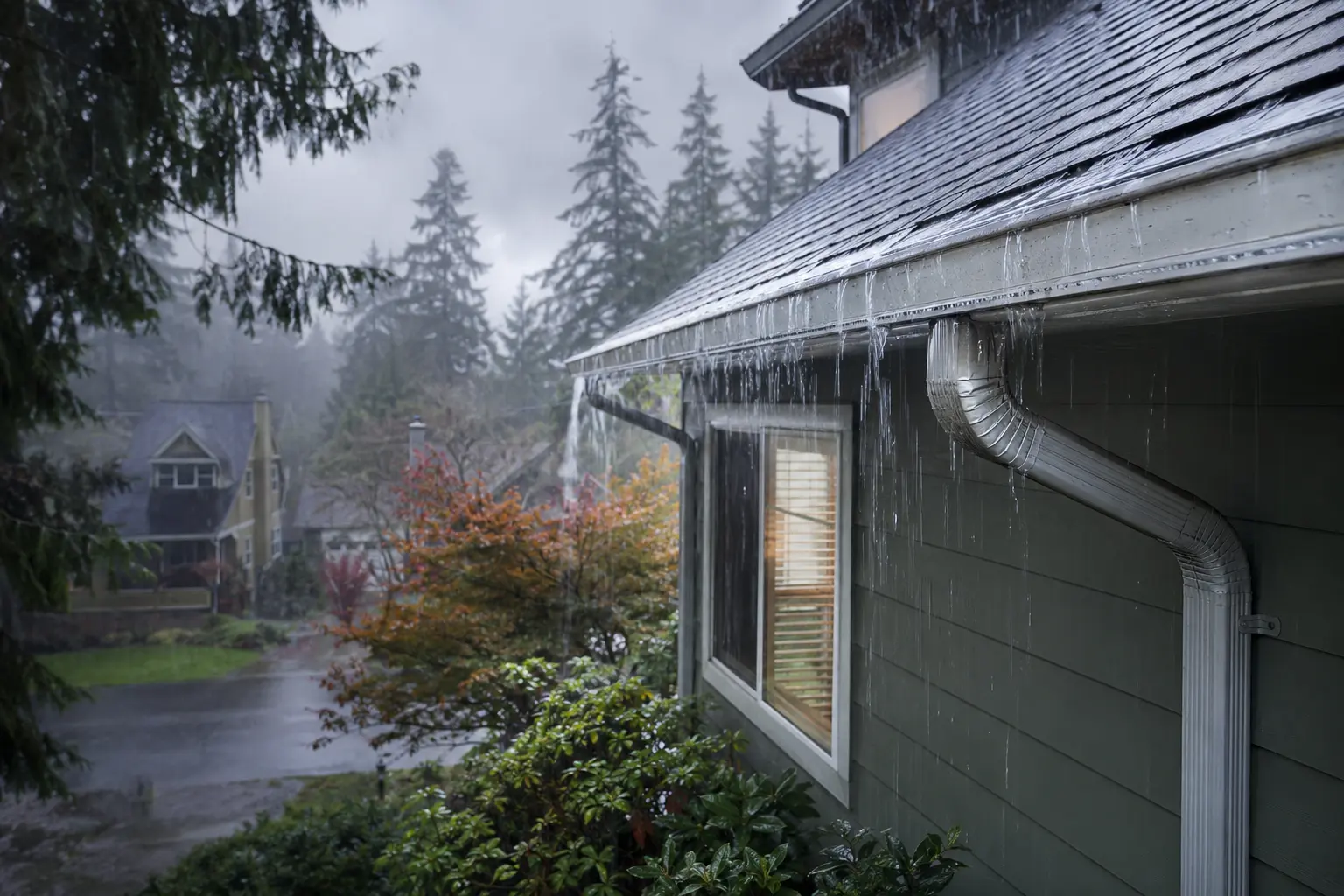
Oregon has a reputation for rain, and it earns it. But here is the part most homeowners get backwards: the amount of water that lands on your roof each year is not what determines the gutter size your home needs.
Two numbers do the real work, and only one of them is the one everyone talks about. This guide breaks down rainfall city by city across the Portland metro and Columbia County, then shows you exactly how that translates into the gutter capacity your roof actually demands.
QUICK ANSWER:
Most Portland-area and Columbia County homes are well served by 5-inch K-style gutters. Despite Oregon’s 40–52 inches of annual rain, our storms are low-intensity, the design rainfall rate near Portland is only about 2.5 inches per hour, versus 8+ in the Southeast. At that rate a 5-inch gutter drains roughly 2,200 square feet of roof per run, which covers the majority of Oregon homes. Step up to 6-inch K-style gutters for large, steep, or tree-heavy roofs and long runs.
What This Guide Covers
How much rain does Oregon actually get, by city?
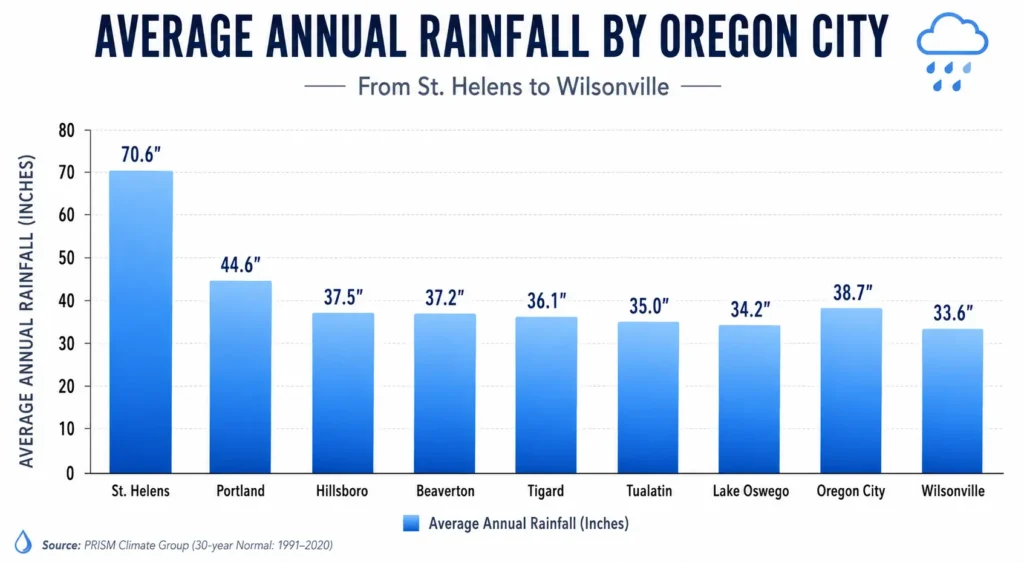
Western Oregon’s climate is mild, marine, and wet for much of the year. Across our service area, average annual precipitation runs from the low 40-inch range in the Washington County suburbs to the low 50s in St. Helens and higher still in the Coast Range foothills. Just as important as the total: it falls across roughly 150 to 180 wet days a year, meaning a Portland gutter is moving water on nearly half the days on the calendar.
Approximate average annual precipitation (rain plus melted snow) for American Gutter Service’s core service cities:
| City | Avg. annual precip. | Notes |
|---|---|---|
| St. Helens | ~48–52 in | Our home base; county seat of Columbia County |
| Scappoose | ~40–44 in | Slightly drier than St. Helens |
| Warren | ~46–50 in | Columbia County corridor |
| Deer Island | ~46–50 in | Columbia County, near the river |
| Rainier | ~46–50 in | Northern Columbia County |
| Clatskanie | ~55–65 in | Wettest — closest to the Coast Range |
| Portland | ~44 in | Metro core; West Hills run far higher |
| Beaverton | ~42–45 in | Washington County, west metro |
| Hillsboro | ~42–45 in | Washington County, west metro |
| Milwaukie | ~44–45 in | South metro, Clackamas County |
| Wilsonville | ~42–44 in | South metro, Clackamas County |
Sources & accuracy: Figures are rounded averages compiled from NOAA Climate Normals (1991–2020) and public climate datasets. Treat them as neighborhood-level estimates, not survey-grade numbers. Elevation and the Coast Range create real microclimates — Portland’s West Hills can receive 50–60+ inches while the valley floor a few miles away sees ~44. For a design-grade figure at a specific address, your roofline is what matters, which is why we measure on site.
Why annual inches is the wrong number for sizing gutters

Here is the counterintuitive truth that surprises a lot of Oregonians: gutters are not sized on how much rain falls in a year. They are sized on rainfall intensity, the peak rate water comes down during a short, hard burst, measured in inches per hour. A gutter that can keep up with the worst five minutes of a storm will keep up with everything milder.
And this is where Oregon is genuinely unusual. We get a lot of rain, but it arrives gently and persistently — drizzle and steady showers, not tropical downpours. The design storm intensity near Portland (the 5-minute, 100-year rate engineers use) is only about 2.5 inches per hour. Compare that with other parts of the country:
| Region | Peak design intensity | Relative to Portland |
|---|---|---|
| Portland / NW Oregon | ~2.5 in/hr | Baseline |
| Chicago, IL | ~5 in/hr | 2x heavier |
| Atlanta, GA | ~6 in/hr | ~2.4x heavier |
| Houston, TX | 8+ in/hr | ~3.2x heavier |
In other words, the same gutter that overflows on a Gulf Coast home can comfortably handle three times the roof in Oregon. (You can look up the exact intensity for any address using NOAA’s Atlas 14 Precipitation Frequency tool.) So if Oregon’s rain is so mild per hour, why do gutters here fail so often? Hold that thought — it is the most important part of this article, and we will get to it after the sizing math.
How gutter capacity is actually calculated
Professional gutter sizing follows the same logic the International Plumbing Code uses. You take three measurements and multiply them:
- Roof drainage area — the footprint of the roof that drains into a given gutter run (in square feet).
- Roof-pitch factor — steeper roofs catch more wind-driven rain, so the area is multiplied by 1.0 (low slope) up to about 1.3 (very steep).
- Rainfall intensity — your local peak rate in inches per hour (about 2.5 for the Portland area).
That gives an “adjusted area,” which you compare against each gutter profile’s rated capacity. Industry capacity ratings are published at a baseline of 1 inch per hour; to adjust for your area you simply divide by your local intensity. (For a fuller walk-through, This Old House has a solid plain-English explainer.)
| THE OREGON MATH, DONE FOR YOUBaseline capacity at 1 in/hr: a 5-inch K-style gutter drains about 5,520 sq ft; a 6-inch about 7,960 sq ft.Divide by Oregon’s ~2.5 in/hr design rate and you get the real local numbers:5-inch K-style → ~2,200 sq ft of roof per run6-inch K-style → ~3,180 sq ft of roof per runFor contrast, that same 5-inch gutter in Houston (8 in/hr) handles only ~690 sq ft. Oregon’s mild storms are why a standard 5-inch system is enough for most homes here. |
So what size gutter does your Oregon home actually need?
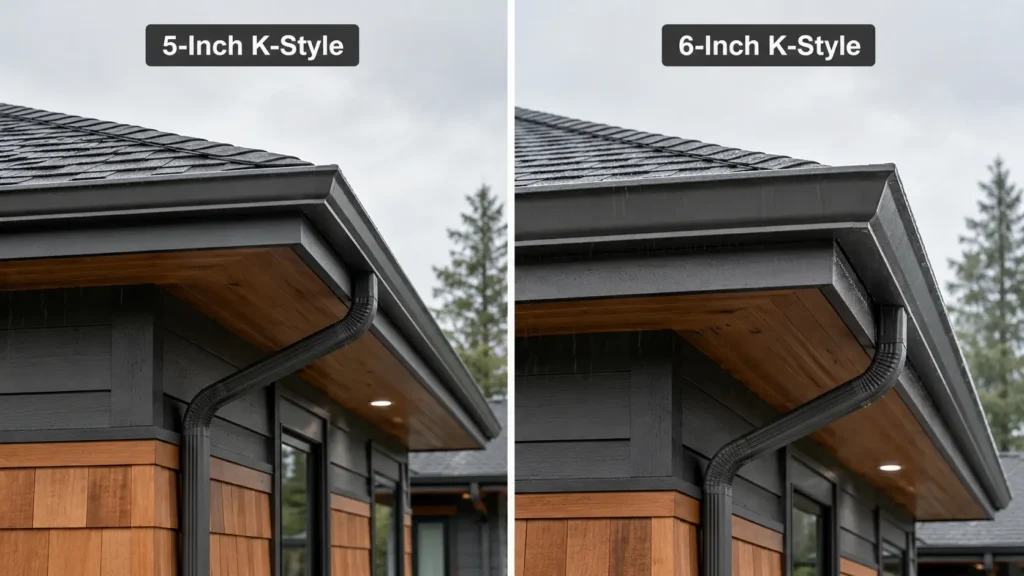
Most single-family roofs in our area concentrate well under 2,200 square feet into any single gutter run, which is why 5-inch K-style is the right call for the majority of Oregon homes. That said, bigger is sometimes genuinely better — not because of how much it rains, but because of roof geometry and trees. Move up to 6-inch K-style gutters if any of these apply to your home:
- A large or complex roof where long planes and valleys funnel water into one run.
- A steep pitch (8:12 or greater) that throws water hard and fast off the eave.
- Long gutter runs of 40+ feet between downspouts.
- Heavy tree cover — fir, cedar, and maple. A wider trough simply holds more debris before it overflows.
Downspouts matter just as much as the trough. As a rule of thumb, plan one downspout for every 30–40 feet of gutter, and on tree-heavy Oregon lots we often upsize to 3×4-inch downspouts because the bigger opening clogs far less readily than a 2×3.
The real threat in Oregon isn’t capacity — it’s debris and chronic saturation
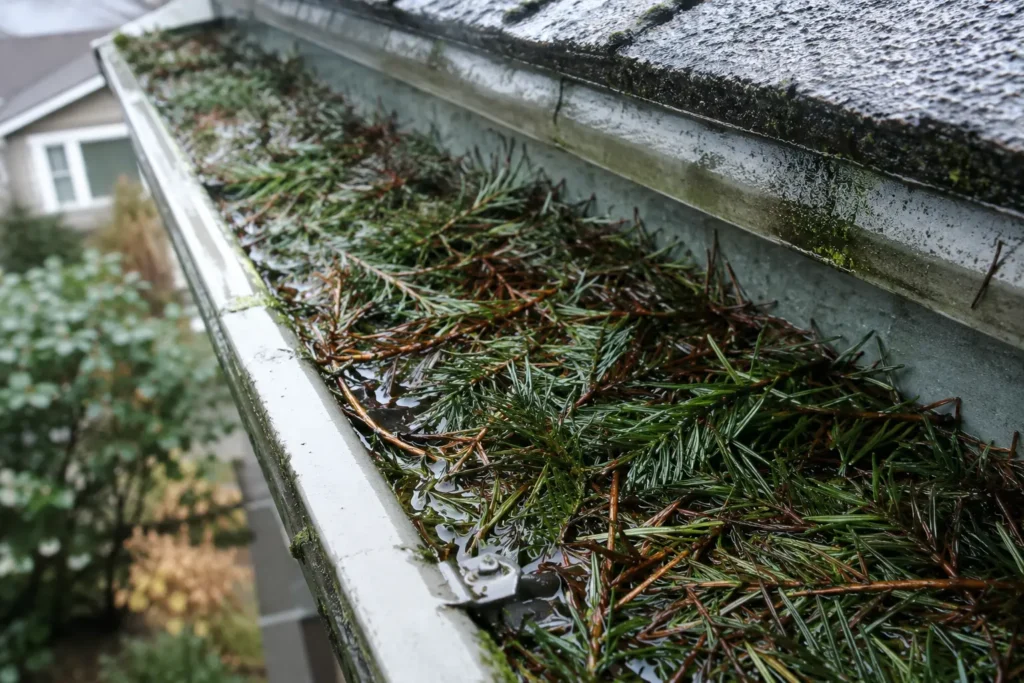
Now back to the question from earlier. If Oregon rain is mild by the hour and a standard gutter has plenty of capacity, why do so many local gutters overflow, sag, and rot fascia? Because the thing that defeats an Oregon gutter is rarely its size. It is everything our climate does over 150–180 wet days a year:
- Organic debris. Douglas fir needles, cedar fronds, and big-leaf maple leaves drop into gutters constantly. Needles in particular knit into a mat that water can’t pass, so the gutter overflows even in a light shower — and even though the trough was never undersized.
- Moss and roof grit. Our damp, shaded roofs grow moss, which sloughs into gutters along with asphalt granules and slowly cements into a sludge that blocks outlets.
- Relentless, low-grade flow. Water moving across the system nearly half the year finds every weak seam, every flat spot, every loose hanger. Small flaws that would never matter in a dry climate become chronic leaks here.
This is why gutters overflow or leak in Oregon far more often than they’re truly outmatched by volume. And it is why the smartest money here usually goes not into oversized troughs but into keeping the system clear and intact: correct pitch, sealed seamless construction, enough downspouts, and debris protection.
| WHAT OREGON RAIN ACTUALLY DEMANDS OF A GUTTER Seamless construction — fewer joints means far fewer leak points over those long wet seasons. Correct pitch & hanger spacing — so water actually reaches the downspout and the trough never sags. Adequate, well-placed downspouts — capacity is wasted if water can’t exit fast enough. Debris protection — gutter guards sized for needles and fir grit, not the leaf-only products marketed in drier states. Routine maintenance — at minimum a fall clean after needle drop and a spring check. |
If your gutters are already pulling away, sagging, or spilling at the corners, the fix may be simpler, or more urgent, than a full replacement. Our guide on whether it’s cheaper to repair or replace gutters walks through the decision, and our gutter repair service diagnoses root cause (pitch, hangers, or age) rather than just patching symptoms.
Do gutter guards make sense in Oregon’s climate?
For most homes under or near conifers, yes. Because debris, not volume, is the dominant failure mode here, a properly chosen guard keeps your existing capacity usable year-round and dramatically cuts cleaning frequency. The key word is properly chosen: fine fir needles and roof grit defeat the cheap wide-mesh and foam inserts that work fine against oak leaves in the Midwest. We size and recommend guards built for Pacific Northwest debris. If you’re weighing the investment, see our Portland-area gutter guard cost guide for current pricing and sizing.
How American Gutter Service sizes gutters for Oregon homes
Numbers on a page are a starting point; your roofline is the real spec sheet. Over 20 years and 1,000+ Oregon installs, our crew has learned exactly how local fascia behaves in November and what a steady atmospheric-river week does to an undersized or poorly pitched system. When we quote a seamless gutter installation, we measure each roof plane, account for pitch and valleys, map debris exposure from your trees, and place downspouts where the water actually wants to go, then form the gutters on site to fit. No guesswork, no stock sizing.
We’re locally owned and based in St. Helens, licensed, bonded, and insured (Oregon CCB #110122). You can read more about our team and history, and every photo on our site is our own actual work across Columbia County and the Portland metro.
Frequently asked questions
How much rain does Oregon get per year?
Across the Portland metro and Columbia County, average annual precipitation runs roughly 40–52 inches. St. Helens averages around 48–52 inches and Portland about 44, while Coast Range–adjacent areas like Clatskanie and Portland's West Hills can exceed 55–60 inches. Just as significant, rain falls across about 150–180 days a year.
Do I need bigger gutters because Oregon rains so much?
Usually not. Gutters are sized on peak rainfall intensity, not annual totals, and Oregon's storms are low-intensity (about 2.5 inches per hour at the design level). A standard 5-inch K-style gutter drains roughly 2,200 square feet of roof per run here, which fits most homes. Size up to 6-inch for large, steep, complex, or tree-heavy roofs.
What size gutters are best for Portland-area homes?
5-inch K-style is the right choice for the majority of Portland-area and Columbia County homes. Choose 6-inch K-style for larger or steeper roofs, runs longer than 40 feet, or properties with heavy fir and maple cover.
What is rainfall intensity and why does it matter more than annual inches?
Rainfall intensity is the peak rate water falls during a short burst, measured in inches per hour. Gutters must keep up with that worst-case rate, so it, not the yearly total, drives sizing. Portland's design intensity is about 2.5 in/hr, far below the 6–8 in/hr seen in the South and Midwest.
Why do my Oregon gutters overflow if they're big enough?
Almost always because of clogs, not capacity. Fir needles, leaves, moss, and roof grit mat together and block flow, so water spills over even in light rain. Too few downspouts and incorrect pitch make it worse. See why gutters leak and overflow.
Are 6-inch gutters worth it in Oregon?
For the right homes, yes. The extra capacity helps less with rainfall volume than with debris tolerance and long or steep runs — a wider trough and larger outlets clog less readily under Pacific Northwest trees. Learn more about 6-inch K-style gutters.
How many downspouts do I need?
Plan roughly one downspout for every 30–40 feet of gutter run. On tree-heavy Oregon lots we often recommend larger 3×4-inch downspouts because the wider opening resists clogging from needles and grit.
Do gutter guards help with Oregon rain?
Yes, because debris is Oregon's main gutter-failure cause. Guards chosen for fine fir needles and roof grit keep your capacity usable and cut cleaning frequency sharply. See our gutter guard cost guide for sizing and pricing.
| GET A GUTTER SYSTEM SIZED FOR OREGON RAIN We’ll measure your roof, factor in pitch, runs, and your trees, and recommend the right size and layout, usually with a same-day written quote. Locally owned, St. Helens–based, CCB #110122. Request your free quote or call (503) 308-1174. |
About the author
Camron Chappelle is the owner of American Gutter Service, a locally owned, licensed (Oregon CCB #110122), bonded, and insured seamless-gutter company based in St. Helens, Oregon. With 20+ years and more than 1,000 gutter installations across Columbia County and the Portland metro, Camron and his crew specialize exclusively in gutters, installation, repair, and guards built for Pacific Northwest rain and debris.
Published: May 28, 2026 • Last reviewed: May 28, 2026