Quick answer:
For most Oregon homes, micro-mesh gutter guards are the best choice. They are the only common guard type with openings fine enough to block the fir needles, moss grit, and roof sediment that clog Pacific Northwest gutters, while still handling the heavy, fast rain we get from November through March. Mesh screens are a budget step up from bare gutters. Reverse-curve, brush, and foam guards all struggle with needles, moss, or our rainfall intensity.
If a salesperson has quoted you on “gutter guards” without telling you which type, pump the brakes.
The five main styles — screen/mesh, micro-mesh, reverse-curve, brush, and foam — perform very differently, and the gap is widest in exactly our conditions: tall conifers dropping fine needles, moss-friendly damp, and rain that can dump more than an inch an hour.
This guide breaks down every type, how it works, what it costs, where it wins, and where it fails, with a Pacific Northwest verdict for each.
We install gutter guards across the Portland metro and Columbia County every week, so the ratings here come from what actually holds up on Oregon rooflines, not marketing footage of dry leaves in Texas.
Table of Contents
How gutter guards work
A gutter guard is any cover or insert that lets rainwater into your gutter while keeping debris out. Every type is solving the same problem, keeping leaves, needles, and grit from forming the wet, rotting plug that causes overflows, fascia rot, and foundation pooling, but they use different physics to do it.
Surface-style guards (mesh, micro-mesh, screen) sit on top of the gutter and filter water through openings.
Surface-tension guards (reverse-curve) use a solid hood that curves water into a slot while debris slides off the edge.
Insert-style guards (brush, foam) sit inside the trough and block debris by filling the space. The finer the filtration, the smaller the debris it stops, but also the more important correct installation and the occasional rinse become.
Important:
No gutter guard is truly “maintenance-free,” especially under conifers. The right guard turns a twice-a-year ladder chore into an occasional rinse. If your gutters already sag or leak, fix that first. See why gutters leak and whether to repair or replace.
Gutter guard types compared at a glance

Here is the quick comparison. Ratings reflect performance on Oregon homes specifically (conifer needles, moss, heavy seasonal rain), based on American Gutter Service field experience and independent testing from This Old House and Bob Vila.
| Guard type | Best for | Main weakness | Oregon fit |
|---|---|---|---|
| Micro-mesh | Fir needles, moss grit, roof sediment, heavy rain | Higher upfront cost; quality varies by brand | Best (5/5) |
| Mesh / screen | Leaves and large debris on a budget | Fine needles and grit can still pass through | Fair (3/5) |
| Reverse-curve | Big leaves where rain is light | Overflows in heavy rain; needles & pests get in | Poor (2/5) |
| Brush | Quick DIY in low-debris areas | Needles and moss lodge in the bristles | Poor (2/5) |
| Foam | Cheapest temporary fix | Degrades; moss and seedlings grow in it | Avoid (1/5) |
1. Mesh & screen gutter guards

HOW THEY WORK
Mesh and screen guards are flat panels, metal or plastic grids, that lay over the gutter opening. Water drains through the holes; leaves and twigs ride over the top. Screen guards have larger openings and are the cheapest, simplest option; metal mesh tightens those openings for better filtration.
PROS
- Affordable and widely available.
- Easy to install, many screen versions need no tools.
- Good at stopping leaves, twigs, and the bulk debris that causes obvious clogs.
CONS
- Standard openings are too large to stop fir needles, shingle grit, or moss particles.
- Cheap plastic screens get brittle and warp in UV and freeze-thaw cycles.
- Debris can still mat on top and needs occasional brushing.
| Oregon verdict — Fair (3/5) A real improvement over bare gutters for leaf-heavy lots, and a sensible budget pick. But under firs and pines, the needles slip straight through standard mesh. If conifers surround your home, step up to micro-mesh. Impact: Medium. Time to see results: immediately after install. |
2. Micro-mesh gutter guards
HOW THEY WORK
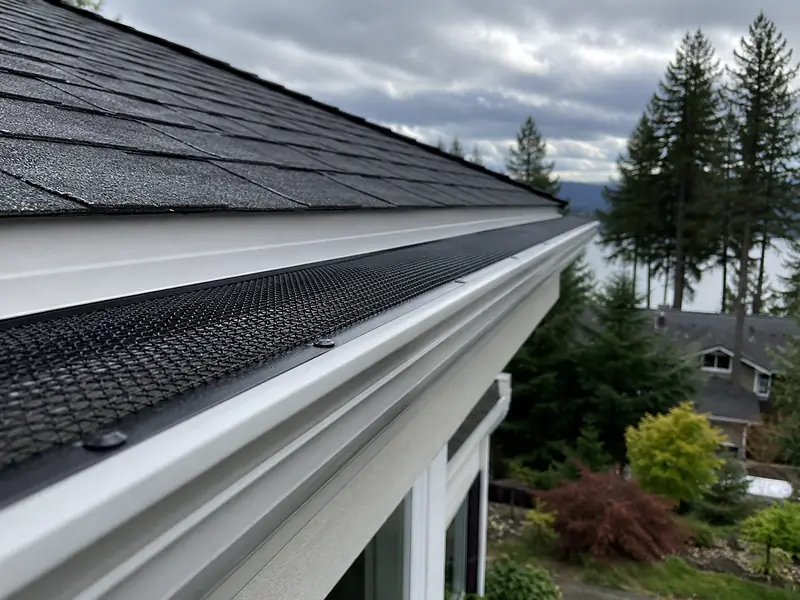
Micro-mesh is the modern gold standard. A finely woven stainless steel mesh, with openings often around 275 microns, sits on a rigid frame over the gutter.
Surface tension pulls water through the tiny holes while needles, grit, pollen, and moss particles stay on top and wash or blow off. In independent testing by This Old House, micro-mesh systems outperformed every other type, and were rated the best option specifically for pine and fir needles.
PROS
- Blocks the finest debris, the only common type that reliably stops fir needles and roof grit.
- Stainless mesh resists rust and won’t warp like plastic.
- Smooth surface sheds debris; the occasional rinse is usually all it needs.
- Handles heavy Pacific Northwest rainfall when installed at the correct pitch.
CONS
- Highest upfront cost of the surface-style guards.
- Quality varies a lot by brand, cheap aluminum mesh can corrode where pine sap and moss sit on it; stainless steel avoids this.
- Spring pollen can film the mesh briefly until the next rain clears it.
| Oregon verdict — Best (5/5) For the vast majority of Oregon homes, especially anything near Douglas fir, cedar, or pine, micro-mesh is what we recommend. It is the one guard type built for our actual debris and our actual rain. Pay for stainless steel mesh and professional installation and it can last decades. Impact: High. Time to see results: immediately, with the payoff compounding every fall and winter. |
3. Reverse-curve (surface-tension) gutter guards

HOW THEY WORK
Reverse-curve guards, sometimes sold as “surface-tension” or “leaf-rejection” systems, use a solid hood with a curved front lip.
Water clings to the curve and rolls into a narrow slot at the back of the gutter; debris is meant to tumble off the front edge. Brands like Gutter Helmet and LeafGuard use this design. (See This Old House on reverse-curve guards.)
PROS
- Good at shedding large leaves.
- Solid top looks seamless from the ground.
- Durable hood material.
CONS
- Surface tension fails when rainfall gets intense, water overshoots the slot and pours over the front, exactly what happens during PNW atmospheric rivers.
- Fine fir needles often follow the water right into the slot.
- The rear slot is an entry point for roof rats, mice, and birds nesting in the trough.
- Snow or ice on the hood can stop it working and contribute to ice dams.
- Often the most expensive option, sometimes requiring full gutter replacement.
| Oregon verdict — Poor (2/5) The surface-tension principle is the wrong bet for our climate. Our rain regularly exceeds the rate at which these hoods can pull water in, so overflow is common, and the needles and pests still get through. We generally steer Oregon homeowners away from reverse-curve. Impact: Low to Negative in heavy-rain zones. Flag: Overflow risk is real here. |
4. Brush gutter guards
HOW THEY WORK
Brush guards are cylindrical bristle inserts, think a giant pipe cleaner, that drop into the gutter trough. The bristles fill the channel so leaves rest on top while water flows around them.
PROS
- Cheap and genuinely easy to install yourself, just lay them in.
- No fasteners or special tools.
- Better than nothing on simple, low-debris roofs.
CONS
- Fir needles and small debris weave straight into the bristles and stay there.
- Moss and seeds collect in the brush and can sprout, yes, we have pulled small plants out of them.
- Cleaning means lifting every section out and shaking it, which defeats the purpose.
| Oregon verdict — Poor (2/5) Brush guards trap exactly the debris our trees produce. In a needle-and-moss climate they become a wick that holds moisture and organic matter in the gutter. Fine for a quick fix on a clean roof; not a real Oregon solution. Impact: Low. Time to clog: often within one fall season under conifers. |
5. Foam gutter guards
HOW THEY WORK
Foam guards are wedge-shaped porous inserts that fill the gutter. Water passes through the foam; debris is meant to sit on top and blow away.
PROS
- Cheapest option and the simplest DIY, cut to length and press in.
- No visible hardware.
CONS
- Foam breaks down under UV and constant moisture, usually within a few years.
- In wet climates, moss, mildew, and even tree seedlings grow directly in the foam.
- Saturated foam holds water against the gutter, accelerating corrosion.
- Fine debris embeds in the surface and is nearly impossible to clean off.
| Oregon verdict — Avoid (1/5) Foam is the worst match for the Pacific Northwest. Our damp turns the insert into a planter and a sponge. We routinely remove failed foam during gutter cleanings. Skip it. Impact: Negative over time. Flag: can shorten the life of the gutter itself. |
Which gutter guard is best for Oregon homes?
Micro-mesh stainless steel gutter guards are the best choice for Oregon homes. They block the fine fir needles, moss grit, and shingle sediment that define Pacific Northwest debris, and they keep draining during the heavy, fast rain that overwhelms reverse-curve hoods.
Mesh screens are an acceptable budget option on leaf-dominant lots; brush, foam, and reverse-curve guards are not well suited to our climate.
Three things make Oregon different from the climates most national gutter-guard ads are filmed in:
- Conifer needles. Douglas fir, pine, and cedar drop fine needles year-round. They pass through standard screens, lodge in brushes, and ride into reverse-curve slots. Only micro-mesh consistently stops them. Independent testing found needles to be one of the most common clog causes nationwide, and that is doubly true here.
- Moss and damp. Our long wet season grows moss on roofs and in gutters. Foam and brush inserts give moss a place to root; smooth stainless micro-mesh does not.
- Rainfall intensity. When four inches falls in a day, surface-tension guards overshoot and overflow. Properly pitched micro-mesh keeps draining.
This is also why correct sizing matters. Pairing micro-mesh with adequately sized 6″ K-style gutters gives water the capacity to move during our heaviest storms. If you are upgrading, it is often worth doing guards and gutter sizing together, our team can assess both during a free estimate.
Gutter guard cost in the Portland area
Installed gutter guard pricing in the Portland metro typically runs $7 to $15 per linear foot, depending on the guard type, your home’s height and roofline complexity, and whether gutters need repair first.
Micro-mesh sits at the upper end because of materials and labor; screen and insert types are cheaper upfront but cost more over time in re-cleaning and replacement.
For a full breakdown by home size, plus how to compare quotes without getting upsold, see our Portland gutter guard cost guide. For an exact number on your home, a free written estimate is faster than any online calculator.
How to choose the right gutter guard
Run through these questions before you buy:
- What falls on your roof? Conifer needles and grit → micro-mesh. Mostly big deciduous leaves and a tight budget → quality mesh screen.
- How hard does it rain where you are? Heavy, fast PNW rain rules out reverse-curve for most homes.
- Do you have a moss problem? If yes, avoid foam and brush — they harbor it.
- What is the mesh made of? For micro-mesh, insist on stainless steel, not aluminum, so sap and moss don’t corrode it.
- Are your gutters sound? Guards on failing gutters just hide the problem. Sort out any leaks or sagging — repair or replace — first.
- Who installs it? Pitch and fit decide whether a guard drains or overflows. Micro-mesh and reverse-curve especially reward professional installation.
Professional installation vs. DIY
Foam and brush inserts are true DIY, you lay them in. Mesh screens are doable for a handy homeowner comfortable on a ladder. But micro-mesh and reverse-curve systems reward professional installation: they must be set at the right angle and sealed to the gutter so water actually drains during a downpour.
A guard installed at the wrong pitch can overflow worse than no guard at all.
There is also the ladder math. Multi-story homes, steep roofs, and Oregon’s slick winter conditions make DIY guard installation genuinely risky.
When American Gutter Service installs your guards, you get our own crew — Camron, Talon, Kai, and Nathan — not a subcontractor, and the work is backed by our workmanship warranty. We serve St. Helens, Beaverton, Portland, and 18+ cities across the metro and Columbia County.
Frequently asked questions
What is the best type of gutter guard?
For most homes, and nearly all Oregon homes, micro-mesh stainless steel guards are the best type. They block the widest range of debris, including fine needles and grit, while still draining heavy rain. Other types are cheaper but trade away performance.
Are micro-mesh gutter guards worth it?
Yes, for homes with conifers or heavy rain. Micro-mesh costs more upfront but is the only common guard type that reliably stops fir needles and roof grit, and quality stainless systems can last decades with only occasional rinsing.
Do gutter guards work with pine and fir needles?
Only micro-mesh works well with needles. Screen, brush, reverse-curve, and foam guards all let needles through or trap them. Independent testing rates micro-mesh as the best guard type for pine and fir needles.
Why do reverse-curve gutter guards overflow?
Reverse-curve guards rely on water clinging to a curved hood. When rain falls faster than the curve can pull it in, common during Pacific Northwest storms, water overshoots the slot and pours over the front edge.
Do gutter guards mean I never clean my gutters again?
No guard is truly maintenance-free. Good micro-mesh turns a twice-yearly cleaning into an occasional rinse. Foam and brush inserts often need more attention, not less, in a damp climate.
How much do gutter guards cost in Portland?
Installed pricing generally runs $7–$15 per linear foot in the Portland metro, depending on guard type and roofline. See our Portland gutter guard cost guide, or request a free written estimate for an exact figure.
Can gutter guards cause ice dams?
They can if the wrong type is used. Solid reverse-curve hoods can trap snow and ice and contribute to ice dams. Open micro-mesh is less prone to this when correctly installed.
Get the right guard for your Oregon home
Still not sure which guard fits your roof? That is what a free, no-pressure estimate is for.
We will look at your trees, your roofline, and your gutters, and recommend the guard that actually makes sense, not the one with the biggest markup.
Call American Gutter Service at (503) 308-1174 or request your free estimate online.
St. Helens-based, locally owned, Oregon CCB #110122 — trusted by 1,000+ Pacific Northwest homeowners.